
Agave Market Breakdown – 2026/27
Why we put this together… A fresh start (and a new home for our insights)
So, it’s a fresh start for us… Facilit8 Ingredients is now Facilitate, with a new look and a brand new website (fashionably late, some might say). Welcome to the first post in our insights series, where we’ll be sharing insight into ingredients supply around organic and added-value products which we’re passionate about.
For anyone new to us, we’re a small Herefordshire-based team supplying organic and natural ingredients to food and drink businesses in the UK and further afield. We started out in 2015 and began importing in 2020, after Brexit cut off one of our consultancy customers’ EU supply routes.
The name and the look have changed, but the way we work hasn’t. We still buy from manufacturers working directly with farmers and cooperatives wherever we can, we still want to know exactly where our ingredients come from, and we’re working towards championing well-made British products alongside responsibly sourcing the things that can’t be grown here.
As you might expect, given it’s our flagship product, we’ve spent a fair bit of time this year looking at where agave is heading, from tequila in the US to syrup, inulin and spirits a bit closer to home. It ended up as a 31-page market breakdown (we love to be thorough), so here are a few of the figures that stood out to us.
If you’d like the full picture, with every chart and source, the complete report is free to download at the end of this post. And if you’re interested in agave as an ingredient, please do get in touch… we’d love to chat.
A maturing US market
US tequila and mezcal sales reached 32.2 million 9-litre cases in 2024, up from 20.1 million in 2019, which works out at roughly 10% a year (DISCUS). Growth eased to around 2% in 2024.
You could be fooled into thinking that’s the start of a decline, but to a certain extent it looks more like a market growing up. IMARC still expects the US tequila market to grow from $9.5 billion in 2025 to $13.8 billion by 2034 (IMARC Group).
For us, the interesting part is what happens next… as the US settles, more attention is turning to Europe and Asia Pacific.
Syrup, and Europe’s slice of it
Agave syrup is still a fairly niche ingredient, but it’s growing steadily. Straits Research puts the global agave nectar market at around $210 million in 2026, rising to $310 million by 2034, and Europe already accounts for 27.4% of it (Straits Research).
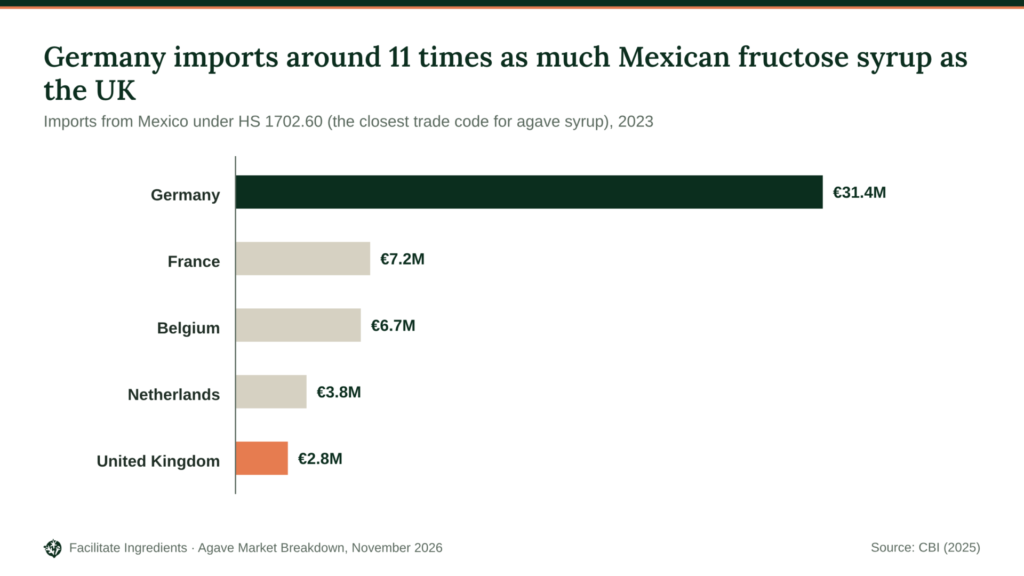
Germany is by far the biggest buyer in Europe, while the UK is still fairly small… which, to a certain extent, is exactly where the opportunity is (CBI).
The supply cycle, and why 2026 (and early 2027!) matters
Agave takes 7 to 10 years to mature, so the market tends to swing between shortage and surplus. At the moment we’re firmly in a surplus.
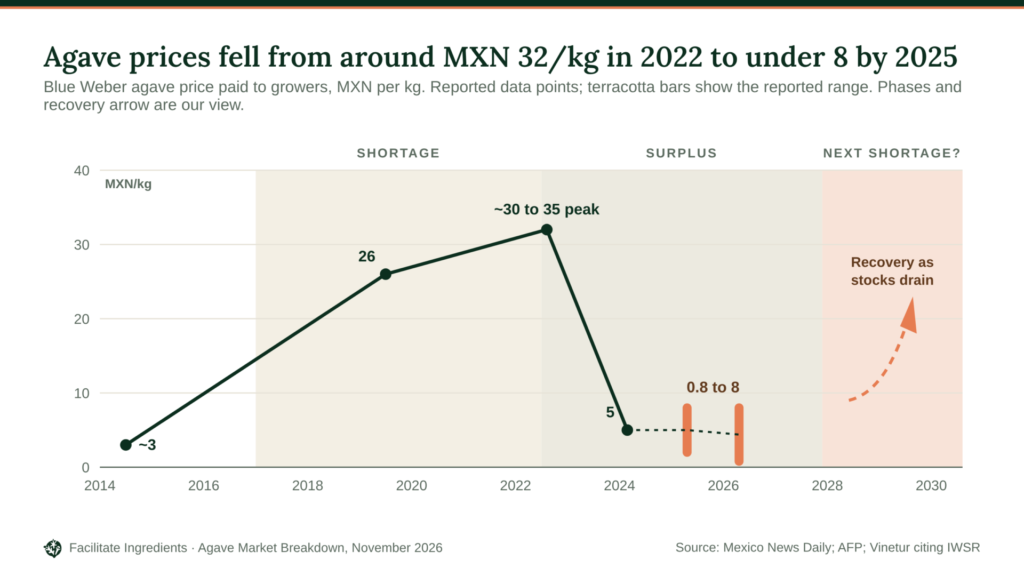
Tequila production fell from 651.5 million litres in 2022 to 495.8 million in 2024 (Vinetur, citing CRT data), and inventories were around 525 million litres at the end of 2023, close to a full year’s production (Mexico News Daily, citing the FT).
Low prices are already putting farmers off planting, so our view is that 2026 to early 2027 is a good window to lock in supply before things tighten up again.
This is of course subject to no further rises in costs of material around the agave itself. Fuel prices, shipping, machinery, packaging costs… these are all set to increase with continued global instability, so paying close attention to the market and timing contracts will be key to getting the biggest “bang for your buck” in the agave market, especially with growing demand.
Why agave works as a sweetener
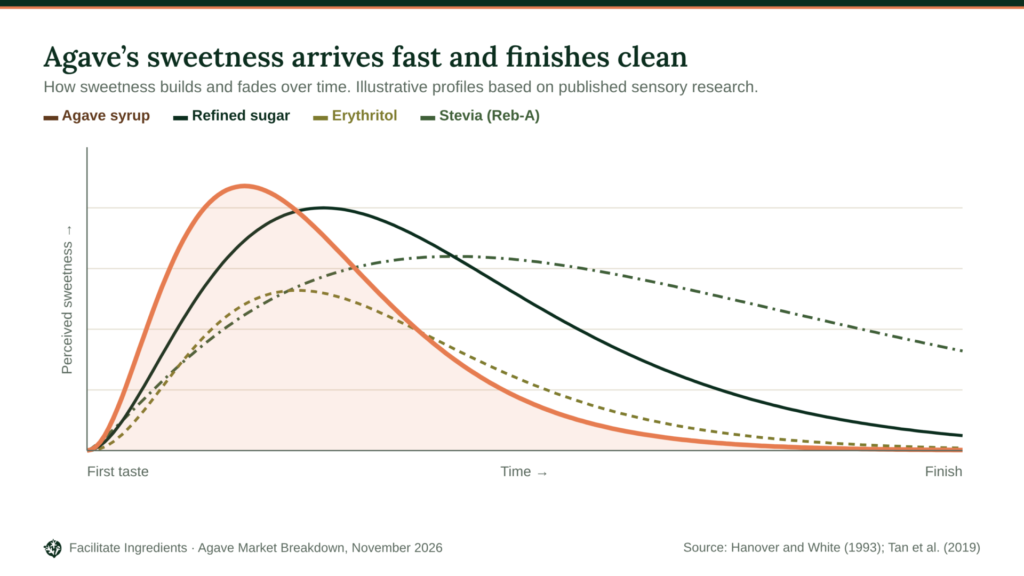
A few things make agave syrup stand out against other sweeteners:
- Clean sweetness. Fructose, the main sugar in agave syrup, is perceived earlier than sucrose, peaks slightly higher and fades more quickly, so you get a quick hit of sweetness without much of a linger (Hanover and White, 1993).
- Lower dosage. It’s around 1.4x as sweet as sugar, so you can use less.
- Low GI. Agave syrup has a glycaemic index of around 15, compared with around 65 for sugar (CBI).
- A helping hand on price. The UK has suspended its import tariff on agave syrup until July 2027 (GOV.UK).
Inulin and the fibre gap
Fibre looks set to be one of the trends of the year. Searches for “high fibre” on Ocado rose 87% year on year (Ocado Retail), yet 96% of Brits still aren’t reaching the recommended 30g a day, with the average adult on around 16g (M&S, citing the National Diet and Nutrition Survey).
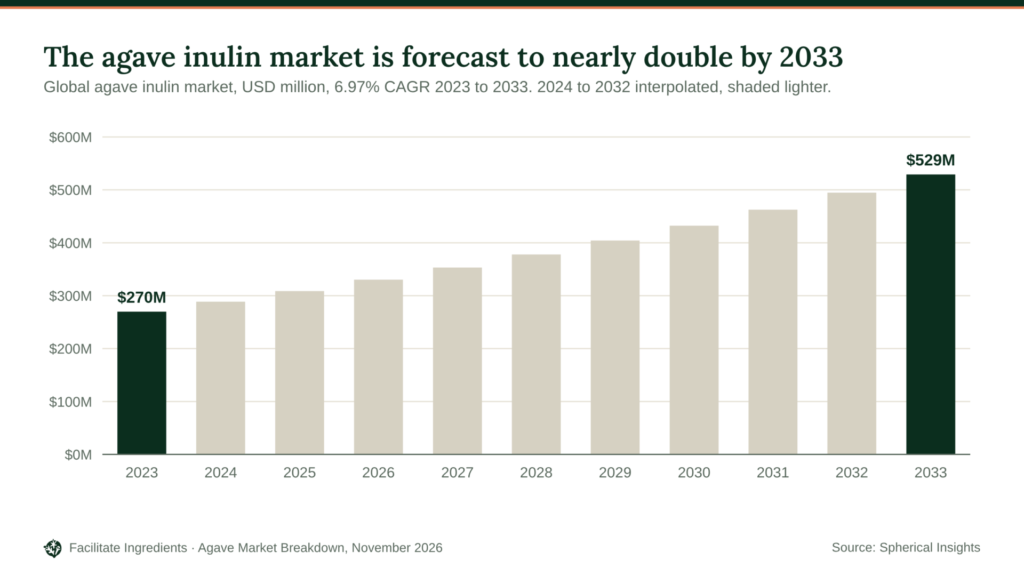
Agave inulin is often organic as standard, unlike most chicory inulin, and comes with a nice Mexican origin story for the label. Spherical Insights expects the agave inulin market to nearly double, from $269.8 million in 2023 to $529.2 million by 2033 (Spherical Insights).
Agave spirits, and a UK angle
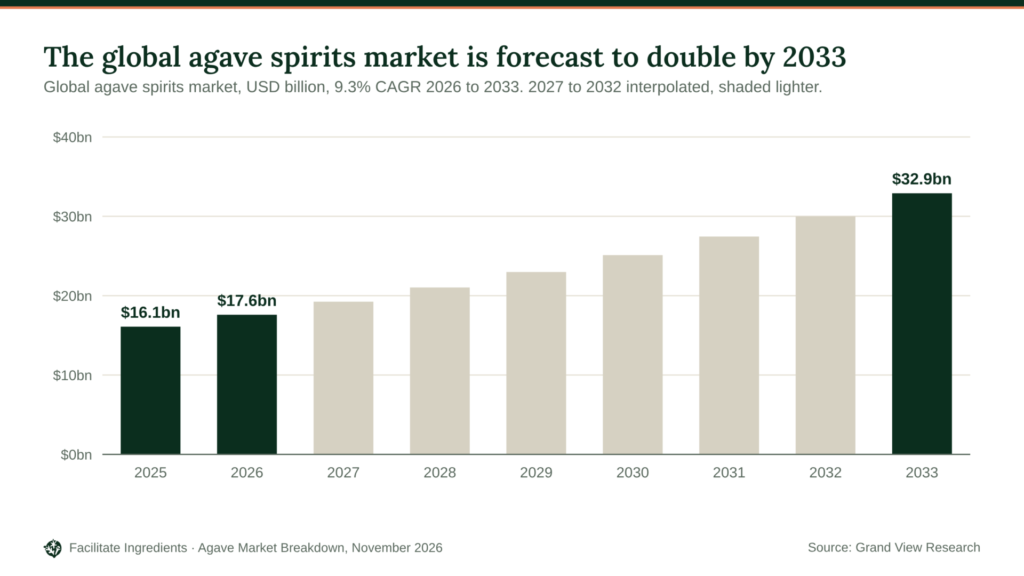
Grand View Research values the global agave spirits market at $16.1 billion in 2025, growing around 9.3% a year to $32.9 billion by 2033, with tequila making up around 78% of revenue (Grand View Research).
Tequila and mezcal have to be made in Mexico (due to DOP status), but agave spirits can be distilled anywhere… and a few UK distilleries are already giving it a go, including Dark Art Distillery in Scotland and Pocketful of Stones in Cornwall. Agave spirits in the UK have grown 57% over the last five years (Park Street), so it’s a space to watch as people continue to discover Mexican cuisine and culture.
There’s a lot more in the full breakdown, including RTD cocktail trends, how agave compares with other sweeteners, the full supply cycle and sources for every figure.
Download the full report
Thanks for reading… and if you’re working on anything agave-related, we’re always happy to chat it through over a coffee (or a margarita, time of day permitting).